
A True Story by Lucian : Shaping Science Fiction

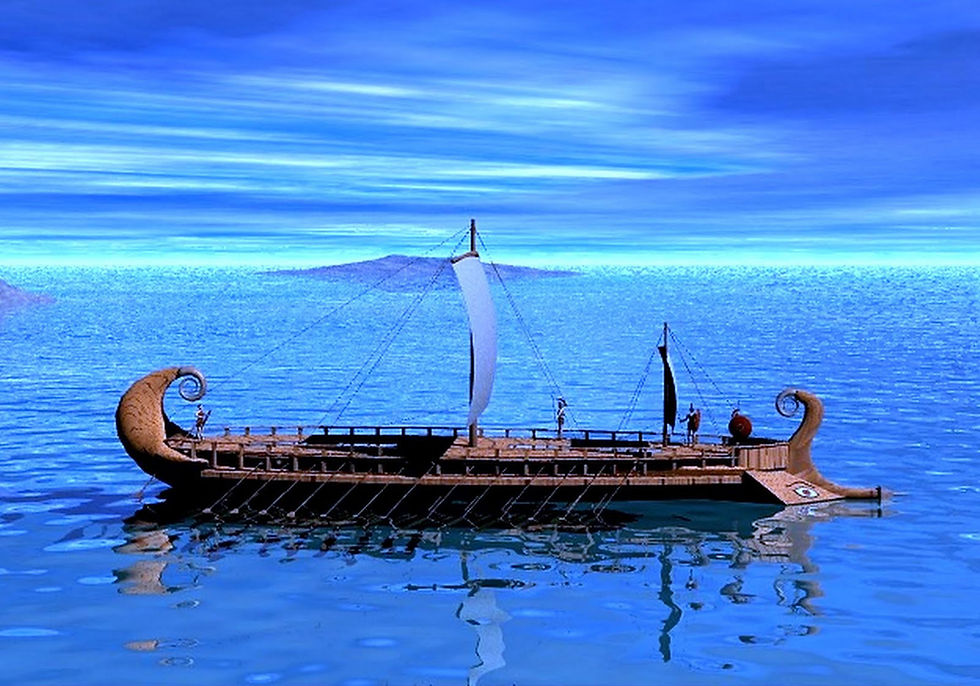
Lucian was born in Samosata, Syria, around 120 AD and was one of the great intellectual travelers of his time. He journeyed through Asia Minor, Italy and mainland Greece, collecting narratives, myths and stories that circulated in the world of the imperial era. Among his works stands out A True Story — a text very often considered one of the earliest examples of science fiction.
Its pages unfold astonishing adventures: arrival on the Moon and war with the inhabitants of the Sun, being swallowed by a sea monster, staying in the land of the Blessed. Lucian himself declares from the very first lines that everything he narrates is true; later readers, however, recognized in his work a subtle parody of the travel narratives that enjoyed great popularity in his time. Whatever his intention may have been, the text vividly captures the ideas, fears and expectations of the ancient world concerning the unknown.

It is no coincidence that centuries later Jules Verne drew inspiration from Lucian to write From the Earth to the Moon and Twenty Thousand Leagues Under the Sea. What in Lucian was considered pure fantasy appears in Verne almost prophetic, foreshadowing technological achievements that would later be realized with rockets, submarines and space travel.
Lucian’s narrative begins with a clear statement of the motivation for the journey: curiosity and the desire for knowledge.
From the Pillars of Hercules, Lucian sails out into the Western Ocean, seeking the limits of the world and the people who live beyond them. This reference already testifies to widespread knowledge of voyages into the Atlantic, but also to the land of the West — the Hesperides — which appears frequently in mythological and religious tradition.

Along his route, Lucian connects the myths of the Greek gods with distant places: Dionysus, Heracles, Athena, Perseus. Traditions of the Maya and other Indigenous peoples of the Americas speak of white, bearded men who came from the East. Archaeological finds reveal Heracles with the lionskin and club, and Perseus holding the severed head of Medusa. The god Dionysus is always accompanied by his favorite symbolic animal — the panther-jaguar.
Greek inscriptions said to have been found on the American continent strengthened the idea of extremely ancient contact.
As the story progresses, Lucian’s Argo is caught in a terrifying whirlwind and lifted into the sky. This whirlwind is symbolically identified with Medusa and with the Styx of the Ocean — a passage between worlds. From there the journey leads to the Moon, a place which, according to Lucian, is inhabited and possesses its own society, king, technology and military conflicts. Similar ideas already appear among the Pythagoreans and in Anaxagoras, showing that the Moon was not regarded merely as a lifeless body.

The descriptions of lunar technology — glass garments, bronze-woven fabrics, mirrors that transmit images and sounds from the Earth — feel strikingly modern. It is hardly surprising that such images reappear today in modern science and space research, which are searching for new ways of processing materials and observing the universe.
Lucian’s journey does not end on the Moon. It includes passages to stars, to the Pleiades, the Hyades, and eventually to the City of Lamps, which is identified with Sirius — the star that shines so intensely “that you can see your shadow at night”.
So, is Lucian’s True Story fantasy or is it real? We will very soon be able to say with certainty. Just as today — and just as then — the truth lies somewhere very close to the impossible and the absurd.
#AncientGreece #GreekMythology #JulesVerne #FromEarthToTheMoon #SpaceExploration #MoonTravel #AncientAstronomy


Comments